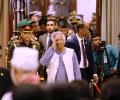
People in Bangladesh have welcomed the new interim government led by Nobel laureate Muhammad Yunus, hoping it would restore order, end repression and hold a fair election to facilitate a democratic transition of power.
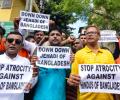
'Prime Minister Sheikh Hasina is sincere about maintaining religious harmony in the country.' 'But for mysterious reasons, it does not reach the grassroots activists of her party.'

'The dominance of her party also meant that the institutions became lopsided -- whether it was the bureaucracy or the courts or the military.' 'She centralised power to the extent that you would see her representatives or her party office bearers having overly represented in these institutions.' 'That perhaps would have been the biggest blunder that she committed.'

Bangladesh's main opposition leader Khaleda Zia has condemned recent attacks on Hindus in different parts of the country allegedly by activists of fundamentalist Jamaat-e-Islami and demanded punishment to perpetrators of the attacks.
At least three people, including two teenagers, were killed as violence rocked Bangladesh for the third day on Saturday as the death toll rose to 49 in clashes that erupted after a top leader of fundamentalist Jamaat-e-Islami was sentenced to death for "crimes against humanity" during the 1971 liberation war.

It's intriguing that the prime minister now wants his American partner to help protect the Hindu minority in Bangladesh. That's conceding to the Americans a pre-eminence India has always contested, resented and feared, asserts Shekhar Gupta.

Raising concern over the nearly 1.25 crore feedback submissions received by the parliamentary committee scrutinising the Waqf (Amendment) Bill, Bharatiya Janata Party member Nishikant Dubey has called for a probe into their sources, including in the possible role of Pakistan's Inter-Services Intelligence and China.

Bangladesh Prime Minister Sheikh Hasina on Sunday secured a record fourth straight term as her Awami League party won two-thirds of the seats in the general elections marred by sporadic violence and a boycott by the main opposition BNP and its allies.
A Bangladeshi court on Thursday handed down the death penalty to 14 people, including the chief of Jamaat-e-Islami and a top leader of India's separatist outfit United Liberation Front of Asom, in the country's biggest ever weapons haul case, nearly 10 years after the seizure took place.

Bangladesh was on the boil on Thursday as at least 23 people, including three policemen, were killed and scores injured in violence after a death sentence was handed down to a top leader of the fundamentalist Jamaat-e-Islami for "crimes against humanity" during the 1971 liberation war.

India on Thursday described as 'matter of serious concern' reports that said some members of the Indian community in Canadian province of British Columbia received 'extortion calls'.

Bangladesh Supreme Court on Wednesday upheld the death sentences handed down to two top opposition leaders convicted for war crimes committed during 1971 independence war against Pakistan, rejecting their final review petitions.

The four-member Appellate Division bench headed by Chief Justice Surendra Kumar Sinha pronounced the single-word judgement at the tense courtroom.
The Bangladesh police on Tuesday arrested two senior leaders of the Jamaat-e-Islami for their role in a massacre during the country's Liberation War in 1971.Muhammad Kamaruzzaman and Abdul Quader Molla were arrested at the gate of the Supreme Court in Dhaka for the massacre in Mirpuri, Dhaka, in 1971. Senior Jamaat-e-Islami leaders including Ameer Motiur Rahman Nizami and General Ali Ahsan Mohammad Mojahid have been named as the co-accused in the case.

Quamruzzaman, an assistant secretary general of Jamaat, is the fourth accused who was convicted for the 1971 war crimes siding with Pakistani troops while his party was opposed to Bangladesh's independence.

The death toll in violence across Bangladesh triggered by the execution of a top Jamaat-e-Islami leader has risen to 21, prompting Prime Minister Sheikh Hasina to issue a stern warning saying, "We know how to control you."

A top leader of fundamentalist Jamaat-e-Islami party and Bangladeshi media doyen Mir Quasem Ali was sentenced to death on Sunday by a special tribunal for war crimes he committed during the independence war against Pakistan in 1971, days after the party's chief was given capital punishment on identical charges.
After the passage of the Eighth Amendment Bill on June 7, 1988, 15 noted personalities had filed a public interest litigation challenging the state religion provision. Many of them are now dead.

Bangladeshis are unwilling to give up peace and growing incomes for the chaos witnessed during the BNP-led four-party alliance rule, says Anand Kumar.

Bangladesh police detained a college student and claimed to have found some "important evidence" in connection with the brutal killing of two gay rights activists.

The death toll in violence across Bangladesh, following dispute over electoral system, rose to six even as the country braced for a 60-hour opposition strike on Sunday, calling for a neutral caretaker government to oversee the next general elections.

Bangladesh's Supreme Court on Monday upheld the death sentence handed down to a fundamentalist Jamaat-e-Islami stalwart for committing mass murder and crimes against humanity during the 1971 liberation war against Pakistan.

A special Bangladeshi tribunal on Wednesday sentenced opposition Bangladesh Nationalist Party's 83-year-old leader Abdul Alim to jail until death for committing large-scale killings and other war crimes during the 1971 Liberation War against Pakistan.
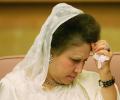
Former Bangladeshi prime minister Khaleda Zia was booked for sedition over her alleged "slanderous comments" concerning martyrs of the 1971 liberation war against Pakistan.
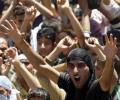
In another blow to Bangladesh's fundamentalist Jammat-e-Islami, the cabinet has decided to strip the voting rights of people convicted of "crimes against humanity" during the 1971 liberation war.

A Hindu tailor was hacked to death by machete-wielding Islamic State militants in his shop on Saturday in central Bangladesh.

Bangladesh's Supreme Court on Thursday upheld a death sentence for top Jamaat-e-Islami leader Abdul Quader Mollah for 1971 crimes against humanity, rejecting his review petition two days after his execution was dramatically put on hold in a last-minute reprieve.

Election Commissioner Shah Nawaz said the Jamaat would not be able to participate in the polls as the high court had declared its registration illegal.
A high-level government committee has accused activists of ruling Awami League alongside main opposition Bangladesh Nationalist Party and fundamentalist Jamaat-e-Islami for the attack on Buddhist temples and localities in south-eastern Bangladesh last month, reports said on Friday.
There has not been any exodus from Bangladesh to West Bengal following violence in the neighbouring country over a top Jamaat-e-Islami leader being sentenced to death for crimes against humanity during the 1971 liberation war.
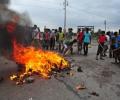
Fundamentalist Jamaat-e-Islami activists on Saturday held violent demonstrations, exploding several homemade bombs, to protest a Bangladeshi court ruling that barred it from contesting future polls.
Bangladesh government on Monday pressed war crime charges against fundamentalist Jamaat-e-Islami (JI) leader Ghulam Azam at the International Crimes Tribunal, calling him a "key collaborator" of the then Pakistani regime during the 1971 Liberation War.
Bangladesh's Supreme Court on Wednesday upheld the death penalty for an influential opposition BNP leader Khaleda Zia for committing crimes against humanity.

The Islamic State has claimed the gruesome killing of a Hindu head priest in Bangladesh using guns and cleavers at a temple in an area bordering India.
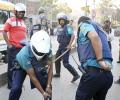
Hardline Jamaat-e-Islami activists on Tuesday exploded crude bombs and clashed with police, leaving at least 40 people injured, during nationwide protests against a court verdict banning it from contesting elections.
A top leader of Bangladesh's fundamentalist Jamaat-e-Islami party was on Thursday sentenced to death for "crimes against humanity", including genocide and religious persecution, during the country's 1971 war of independence against Pakistan.
Earlier, two former cabinet ministers of the Bangladesh Nationalist Party-led alliance government, Abdul Mannan Bhuiyan and Shamsul Islam were sent to Dhaka Central Jail after they surrendered before the court.
Security agencies are apprehensive that the Jalpaiguri blast is merely an indicator of the unrest triggered by fundamentalist outfit Jamaat-e-Islami along the India-Bangladesh border, says Vicky Nanjappa

Thursday's savage murder of writer Avijit Roy in Dhaka raises troubling questions about religion-inspired terror in Bangladesh.

Tarun Vijay visits 20 Durga Puja pandals in five towns in Bangladesh and comes back impressed.
 © 2026 Rediff.com - Advertise with us - Disclaimer - Privacy Policy - Sitemap - Feedback - About us - Terms of use - Grievances